For diesel engine users , the quality of the leak off pipe is directly linked to fuel system stability and engine service life. Inferior or aged leak off pipes not only cause fuel waste and pressure anomalies but also trigger engine failures and increase maintenance costs. Based on industry standards and hands-on experience, this article shares 5 simple yet effective methods to test leak off pipe quality. Combined with Standards Rubber’s product advantages, it also recommends compatible accessories to help practitioners and vehicle owners accurately judge product quality and avoid procurement risks.
1. Basic Visual Inspection: Quickly Identify Obvious Defects
Visual inspection is the first line of defense for evaluating leak off pipe quality. It requires no professional tools and is a core step for on-site purchasing.
During inspection, first check material integrity: A high-quality leak off pipe should be made of fuel-resistant and high-temperature-resistant special materials (such as PA or metal used in Standards Rubber’s products). Its surface must be smooth and flat, free of cracks, bubbles, scratches or impurity protrusions. If the material is brittle, uneven in color or rough in texture, it indicates substandard raw materials with significant usage risks. Second, verify dimensional accuracy: Use a caliper to measure the pipe’s inner diameter, outer diameter and interface size, which must fully comply with the original vehicle’s OEM standards. For example, the 31400-4X700 fuel return line for Hyundai models. Excessive dimensional deviation will lead to loose installation and fuel leakage. Finally, inspect interface sealing: Check for burrs, deformation, intact threads or buckles at the interface. The interfaces of Standards Rubber’s leak off pipes are precision-machined, and when paired with quick connectors, they achieve seamless fit to completely eliminate air leakage risks.
2. Pressure Test: Core Verification of Sealing Performance
Pressure testing is a key method to determine whether a leak off pipe can meet the high-pressure operating conditions of an engine. It effectively detects hidden leakage issues invisible to the naked eye.
Prepare basic tools before testing: pressure test pump, sealing plugs, pressure gauge and soapy water. The specific test procedure is as follows:
1. Seal both ends of the leak off pipe with sealing plugs, and connect the pressure test pump and pressure gauge to the pipeline;
2. Slowly increase the pressure to the normal operating pressure range of a diesel engine (usually 0.3–0.5MPa) and maintain stable pressure for 30 minutes;
3. Observe the pressure gauge reading changes and apply soapy water to the interfaces. If there is no pressure drop and no bubbles, the sealing performance is qualified. If pressure drops or bubbles appear, the pipeline has leakage points.
All series of Standards Rubber’s leak off pipes (such as model A6130700032 for Mercedes-Benz) have passed factory pressure tests. Their pressure resistance far exceeds industry standards, enabling them to directly meet the high-pressure operating requirements of heavy-duty diesel engines without additional testing.
3. Material Corrosion Resistance Test: Adapt to Harsh Working Conditions
Diesel engines operate in complex environments. Leak off pipes are in long-term contact with fuel and high-temperature exhaust gas, so material corrosion resistance is crucial.
The simple test method is as follows: Cut a section of the leak off pipe sample and soak it in diesel oil at room temperature for 72 hours. A qualified product should show no expansion, deformation or cracking after being taken out, with no fuel residue adhering to the surface. If the material softens, discolors or swells, it indicates insufficient corrosion resistance and is prone to aging and damage during use.
Standards Rubber’s leak off pipes adopt imported fuel-resistant formulas. Some models (such as model 3415562 for Cummins engines) are also treated with a special anti-corrosion coating, making them suitable for long-term high-temperature and high-oil environments. Their service life is more than 30% longer than ordinary products.
4. Compatibility Test: Ensure Integration with Engine Systems
Even if the appearance and performance meet standards, poor compatibility between the leak off pipe and other engine components will still affect the overall stability of the fuel system.
The compatibility test consists of two steps: The first step is installation compatibility testing. Pre-install the leak off pipe with the engine’s fuel injection system and fuel hose to check if installation is smooth without forced bending or loose interfaces. The second step is cooperative operation testing. Start the engine and observe the leak off pipe’s performance under different operating conditions such as idling and acceleration. No shaking, falling off or abnormal noise indicates good compatibility.
To ensure system compatibility, it is recommended to pair with Standards Rubber’s high-pressure fuel hoses and quick connectors. These two types of products use the same source materials and unified interface standards as the leak off pipes, further improving the sealing and stability of the fuel system.
5. Brand and Certification Inspection: Choose a Reliable Supplier
In addition to hands-on testing, brand reputation and certification qualifications are important guarantees of product quality, especially for bulk procurement scenarios.
Focus on three key points during inspection: First, check certification documents. High-quality leak off pipes should have international certifications such as ISO and SGS. All series of Standards Rubber’s leak off pipes comply with ISO 9001 standards, with strict guarantees for production processes and product quality. Second, verify vehicle compatibility qualifications. The product must clearly mark compatible vehicle models and OEM numbers (such as model LR022590 for Land Rover and model 13537799450 for BMW), avoiding unqualified universal inferior products. Third, confirm after-sales support. A reliable supplier should provide quality inspection reports and return/refund services.
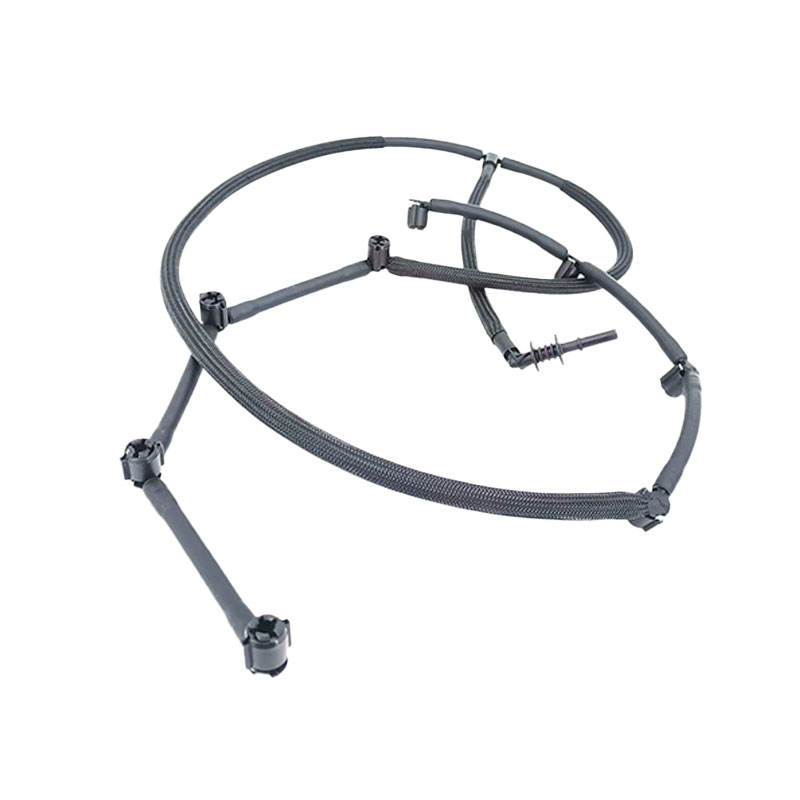
OEM LR022590 AH4Q-9K022-CC Leak Off Pipe to Fuel Injectors
6. Recommended Accessories After Testing
If the leak off pipe is confirmed to be qualified after testing, pairing it with the following accessories can further improve fuel system performance:
Compatible Accessories | Product Advantages | Application Scenarios |
Fuel Hose | High pressure and fuel resistance, compatible with leak off pipe materials | Fuel delivery for passenger cars and light commercial vehicles |
Hydraulic Hose | Ultra-high pressure resistance and impact resistance | Heavy-duty diesel engines and engineering vehicles |
Quick Connector | Easy installation and strong sealing performance | Connection of leak off pipes and fuel hoses for all vehicle models |